The roads which are carrying more than 1000 vehicles per day is called High traffic roads. National and State highways fall under this category.
National highways run throughout the length and breadth of the country. These roads connect state capital cities to the national capital city. A minimum of two lanes, one for each direction is provided for National highways and these two lanes are divided by a strip of boulders.
The minimum speed of 80Kmph should be maintained on National highways. They are usually labelled with numbers NH1, NH70
State Highways connects the important cities of the state to the state capital city. State highways give access to connect National highways. They are also connected to the state highways of the neighbouring states.
A minimum of two lanes are provided but they may or may not divided with a strip of boulders.
District roads give access to connect to the State highways. District roads connect the important towns of the district and they are also connected with the neighbouring district roads.
There are two different types of district roads
Freeways are also called as access-controlled highways.
Freeways are wide roads designed for fast-moving vehicles to travel long distances with higher speeds. These are generally designed in four lanes, two lanes in each direction. Traffic movement on freeways is continuous and unhindered because there are no railway or road intersections and no signals.
As mentioned above, access is controlled everywhere in this type of roads the driver never comes in contact with the opposing flow of traffic. To separate traffic from other roads Freeways are accessed only through ramps. Bridges or underpasses are constructed to create a passage for roads which cross freeways.
You can see from the above image that there is no obstruction and free flow of traffic in each direction.
Parking and Walking are strictly prohibited on freeways and they don’t have footpaths on either side of roads.
The minimum speed limit and maximum speed limit varies from the country by country and it ranges between 45mph to 75mph.
Expressways are one of the superior types of access-controlled roadways where the entry and exit of the expressway are fully controlled by ramps.
As the name itself “express” echoing that these are meant for a free flow of very speed traffic. Expressways are designed to travel quickly with great comfort and safety by avoiding sharp curves, busy traffic intersections, railway junctions.
Vehicles with high acceleration are only permitted in expressways. Heavy load vehicles, cargo vehicles, pedestrians are not allowed.
Parking, loading and unloading are strictly prohibited on Expressways.
You can see clearly the access is controlled by the left side ramp to join with the expressway.
Highways connect villages to cities or cities to cities or state to state or the roads connect the state capital to the national capital are called highways. Highways are the roads run through the length and breadth of the country. They are generally laid in two lanes. Highways are further classified into National Highways, State Highways, Urban Highways and Rural Highways. We will discuss these types in location and function category.
Arterials are the roads laid inside the city or town for the movement high volume of traffic. An arterial road joins the central business point to the outside residential areas. Arterials provide access to the highways.
Pedestrians are allowed to cross the roads only at intersections or at designated pedestrian crossings. The flow of traffic is controlled by a signalling system at intersections.
Parking is not allowed on arterial roads.
In the above image, white lanes and yellow lanes denote arterials
Pedestrians can cross the road at any point in local streets. Unrestricted parking, loading and unloading of vehicles are allowed in local streets. They usually don’t have any divider with boulders but divided with 1m dotted white lines or straight white line.
Collector roads collect and deliver the traffic to and from local streets and arterials. The speed limit usually ranges between 35-55km/hr.
Pedestrians are allowed to cross only at intersections. Parking can be allowed except at peak times.
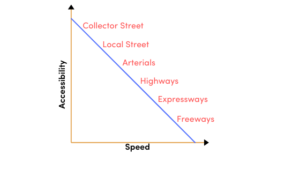
The below graph represents the speed and accessibility for different types of roads
The roads which are accessed only during the fair atmospheric conditions are called Fairweather roads. Some roads are opened only during summers and rest all seasons the roads remained closed due to snow on road. These roads are not accessible during heavy rains, cyclones or at the time of floods.
The roads which are laid with the available soil at the site are called Earthen Roads. These are the cheapest roads among all the roads. Earthen roads are designed for very low volume traffic.
Available soil is laid in two-three layers and surface of the road is compacted with the rammer to expel the excess voids present in the soil. roads are also called as temporary roads usually laid for moving constructing vehicles while building a structure or for moving army vehicles during war times.
it is not recommended to go with Earthen roads in monsoon as the soil may runoff during rain.
This type of road is also called as WBM road. The crushed stone (aggregate) is used as a base course. WBM roads are laid as layers. Aggregates are spread on the surface as a layer having 10cm thickness, water is sprinkled on each layer and then rolled for a better finish.
These roads are better than the Murram, Earth and Kankar roads.
In cities WBM is usually laid in pit holes.
The bituminous is a black viscous and adhesive material occurred during the distillation of petrol. Bituminous roads are primarily used all over the world which is very easy to lay and provides smooth and good surface finish. The thickness of bitumen road depends upon the subgrade soil at the site. It is always recommended to lay the bitumen roads in two layers.
The roads which are laid using the cement concrete material is called concrete roads. These are the costlier roads among all type of roads. This type of roads are recommended at the places of the high volume of traffic and it takes more time to construct the concrete roads as the concrete requires proper curing. The average life of a concrete road is 40 years whereas bituminous road has an average life of 3 years.
The flexible road has four layers, the outer surface layer is topped with bituminous material which is called as wearing course and an underlying sub-base, base and subgrade course. All these layers make the road flexible. Periodic maintenance is required for flexible roads otherwise it can disintegrate easily with heavy traffic.
All roads except cement concrete roads are flexible roads.
These are the roads with only three layers (Surface course, Base and Subgrade course) makes road non-flexible. Cement concrete road falls under this category.
Flexible roads consist of a flexible layer as a pavement surface, which requires proper maintenance; otherwise, it can be disintegrated easily with heavy traffic. All types of roads except concrete roads fall under this category.


No comments:
Post a Comment