Friday, March 1, 2024

What is Liv Pure #health&Fitness #weightloss #Livrpure https://youtube.com/shorts/idRzxvqUriw?si=Pay7rlt1CwR-lwzI


Liv Pure is a brand that specializes in providing solutions for health, wellness, and environmental concerns. Their product range includes water purifiers, air purifiers, fitness equipment, nutritional supplements, and other items geared towards promoting a healthy lifestyle.

1. Water Purifiers: Liv Pure offers a variety of water purification systems designed to remove impurities and contaminants from drinking water. These may include sediment, chlorine, heavy metals, bacteria, viruses, and other harmful substances. Their water purifiers often utilize multiple stages of filtration, including sediment filters, activated carbon filters, reverse osmosis membranes, and UV sterilization, to ensure clean and safe drinking water.

For more details CLICK here : Live Pure

2. Air Purifiers: Liv Pure's air purification systems are designed to improve indoor air quality by removing airborne pollutants such as dust, pollen, pet dander, mold spores, smoke, and volatile organic compounds (VOCs). These purifiers typically use HEPA filters, activated carbon filters, ionizers, and UV-C light to capture and neutralize pollutants, providing cleaner and fresher air for breathing.

3. Fitness Equipment: Liv Pure also offers fitness equipment designed to help individuals achieve their exercise and wellness goals. This may include items such as treadmills, exercise bikes, elliptical trainers, strength training equipment, yoga mats, and accessories. Their fitness products are designed to be durable, functional, and effective for home or commercial use.

4. Nutritional Supplements: Liv Pure provides a range of nutritional supplements aimed at supporting overall health and wellness. These supplements may include vitamins, minerals, protein powders, pre-workouts, post-workouts, and other dietary supplements formulated to enhance energy levels, recovery, muscle growth, and overall performance.                                            For more details CLICK here : Live Pure      

5. nvironmental Consciousness: Liv Pure emphasizes environmental consciousness in their product design and manufacturing processes. They may incorporate energy-efficient technologies, sustainable materials, and eco-friendly practices to reduce their carbon footprint and promote sustainability.

Overall, Liv Pure aims to empower individuals to lead healthier lifestyles by offering high-quality products that address key aspects of health, wellness, and environmental well-being. Their comprehensive range of solutions caters to various needs and preferences, making them a popular choice for individuals seeking to improve their overall quality of life.

For more details CLICK here : Live Pure

Saturday, February 24, 2024

A Basic Guide To Affiliate Marketing #affiliatemarketing #digitalmarketing #ebusiness&emarketing #workfromhome

A Basic Guide To Affiliate Marketing
1. Understand Affiliate Marketing: Affiliate marketing is a performance-based marketing model where businesses pay affiliates (publishers or marketers) a commission for promoting their products or services and driving sales or leads.

2. Choose Your Niche: Select a niche that you are passionate about or have expertise in. This will make it easier to create content and promote products within that niche.

3. Research Affiliate Programs: Look for affiliate programs that align with your niche. Popular affiliate networks like Amazon Associates, ShareASale, and Commission Junction offer a wide range of products and services to promote.

4. Build Your Platform: Create a platform where you can promote affiliate products, such as a blog, website, YouTube channel, or social media presence. Focus on providing valuable content to your audience related to your niche.

5. Select Products to Promote: Choose products or services that are relevant to your audience and provide value. Consider factors like commission rates, product quality, and demand.

6. Create High-Quality Content: Develop content that educates, entertains, or solves problems for your audience. This could include product reviews, tutorials, comparison articles, or how-to guides.

7. Promote Affiliate Links: Integrate affiliate links naturally into your content, ensuring they are relevant and add value to your audience. Avoid being overly promotional or spammy.

8. Track and Analyze Performance: Monitor the performance of your affiliate marketing efforts using tracking tools provided by affiliate networks or third-party software. Analyze metrics like clicks, conversions, and earnings to optimize your strategy.

9. Optimize for Conversions: Continuously test and optimize your content, promotions, and placement of affiliate links to improve conversion rates and maximize earnings.

10. Comply with Regulations: Familiarize yourself with relevant regulations and guidelines governing affiliate marketing, such as disclosure requirements, to ensure compliance and maintain trust with your audience.

Remember, success in affiliate marketing takes time and effort. Stay patient, continue learning, and adapt your strategy based on feedback and results.

For Best Results Click Below :


A concise guide to working from home effectively #workfromhome #onlineearning #emarketing #ebusiness #onlinebusiness #digitalmarketing #career

A concise guide to working from home effectively


Here's a concise guide to working from home effectively:

1. Establish a Dedicated Workspace:
Designate a specific area in your home for work to create a productive environment and maintain a boundary between work and personal life.

2. Stick to a Routine: Maintain a consistent schedule, including regular work hours, breaks, and meal times, to stay organized and focused.

3. Dress for Success: While you may not need to dress as formally asd in an office, getting dressed in comfortable yet presentable attire can help shift your mindset into work mode.

4. Set Clear Boundaries: Communicate your work hours and availability to family members or roommates to minimize distractions and interruptions.

5. Use Technology Wisely: Utilize collaboration tools, project management software, and communication platforms to stay connected with colleagues and effectively manage tasks.

6. Take Regular Breaks: Incorporate short breaks throughout your day to recharge and avoid burnout. Stretching, walking, or engaging in quick relaxation exercises can help maintain focus and productivity.

7. Stay Organized: Create to-do lists, prioritize tasks, and set achievable goals to stay on track and manage your workload effectively.

8. Communicate Effectively: Maintain regular communication with your team through video calls, emails, or instant messaging to ensure alignment and collaboration.

9. Minimize Distractions: Identify potential distractions in your environment and take steps to minimize them, whether it's turning off notifications or using noise-canceling headphones.

10. Practice Self-Care: Prioritize your physical and mental well-being by incorporating healthy habits such as exercise, proper nutrition, and adequate sleep into your daily routine.

11. Seek Support When Needed: Don't hesitate to reach out to your manager or colleagues for assistance or clarification on tasks, and prioritize your mental health by seeking professional support if necessary.

12. Reflect and Adapt: Regularly evaluate your work-from-home setup and routines, making adjustments as needed to optimize your productivity and well-being.

By implementing these strategies, you can create a conducive environment for remote work and maximize your effectiveness while enjoying the flexibility and convenience it offers.

For Best Results Click Below:

Friday, February 23, 2024

The Holistic Approach to Health and Fitness #Health&Fitness #okiwanaflatbellytonic #TopThyroidProduct #FastLeanPro #Puravive #Sugar Defender - New Blood Sugar and Type 2 #Nagano Tonic #Sumatra Slim Body Tonic #Slim Guard #Cortexi - Hearing and Brain Health #The Genius Wave https://youtube.com/shorts/idRzxvqUriw?si=Pay7rlt1CwR-lwzI

The Holistic Approach to Health and Fitness

In today's fast-paced world, prioritizing health and fitness is more important than ever. Achieving optimal health isn't just about hitting the gym; it's a holistic journey encompassing physical, mental, and emotional well-being. Here, we'll explore key elements of this journey and how to integrate them into your lifestyle for lasting health and fitness.

1. Physical Activity : Regular exercise is the cornerstone of a healthy lifestyle. Aim for a mix of cardiovascular, strength training, and flexibility exercises to improve endurance, strength, and flexibility. Find activities you enjoy, whether it's cycling, swimming, yoga, or dancing, and make them a regular part of your routine.

2. Nutrition : Fuel your body with nutrient-dense foods that support overall health and fitness. Emphasize whole foods such as fruits, vegetables, lean proteins, whole grains, and healthy fats. Stay hydrated by drinking plenty of water throughout the day, and limit processed foods, sugary drinks, and excessive alcohol intake.

3. Rest and Recovery : Rest is essential for allowing your body to repair and recharge. Aim for 7-9 hours of quality sleep each night to support physical recovery and mental well-being. Incorporate rest days into your workout schedule to prevent burnout and reduce the risk of injury.

4. Stress Management : Chronic stress can negatively impact both physical and mental health. Practice stress-reducing techniques such as mindfulness meditation, deep breathing exercises, yoga, or spending time in nature. Prioritize activities that bring you joy and relaxation to promote overall well-being.

5. Mental Health : Physical health and mental health are closely intertwined. Take care of your mental well-being by seeking support when needed, whether through therapy, support groups, or talking to trusted friends or family members. Prioritize self-care activities that nourish your mind, such as journaling, hobbies, or spending time with loved ones.

6. Consistency and Balance : Consistency is key to long-term health and fitness success. Set realistic goals and create a balanced routine that you can maintain over time. Listen to your body and adjust your approach as needed, finding harmony between pushing yourself and giving yourself grace.

7. Community and Support : Surround yourself with a supportive community of friends, family, or like-minded individuals who share your health and fitness goals. Accountability partners can help keep you motivated and accountable on your journey, providing encouragement and celebrating your successes.

Conclusion : Achieving optimal health and fitness is a multifaceted journey that requires a holistic approach. By prioritizing physical activity, nutrition, rest, stress management, mental health, consistency, and community support, you can create a sustainable lifestyle that enhances your overall well-being. Remember, small, consistent changes over time can lead to significant improvements in your health and quality of life.


Monday, February 19, 2024

Health Awareness And Weight Loss #health&Fitness #thesmoothiediet

Health awareness and weight loss are closely linked. Being aware of the importance of maintaining a healthy weight can motivate individuals to make positive lifestyle changes such as adopting a balanced diet, engaging in regular exercise, getting enough sleep, managing stress, and avoiding harmful habits like smoking or excessive alcohol consumption. It's essential to approach weight loss in a sustainable way, focusing on long-term habits rather than quick fixes or fad diets. Consulting with a healthcare professional or a registered dietitian can provide personalized guidance and support on achieving and maintaining a healthy weight. 

The Smoothie Diet is a popular 21-day weight loss program : 
The Smoothie Diet is a popular 21-day weight loss program that revolves around consuming smoothies as meal replacements. Typically, participants replace one or more meals per day with a nutrient-dense smoothie made from fruits, vegetables, protein sources, and healthy fats. These smoothies are often low in calories but high in vitamins, minerals, and fiber, which can aid in weight loss and improve overall health. The program usually includes a specific smoothie recipe plan for each day, along with guidelines for incorporating healthy snacks and balanced meals.
While some people may find success with the Smoothie Diet in terms of short-term weight loss, it's important to approach any diet program with caution and consideration of individual needs and preferences. It's also crucial to ensure that the smoothies provide adequate nutrition and are not overly restrictive in calories or food groups. Consulting with a healthcare professional or a registered dietitian before starting any new diet program can help ensure it aligns with your health goals and is safe for you to follow.

Sunday, February 18, 2024

The Ultimate Guide to Weight Loss and Fitness #health&Fitness #fastleanpro

The Ultimate Guide to Weight Loss And Fitness
The Ultimate Guide to Weight Loss and Fitness:

Achieving Your Goals Embarking on a weight loss journey can be both challenging and rewarding. It requires dedication, patience, and a holistic approach to achieve sustainable results. Let's explore some effective strategies and tips to help you reach your weight loss and fitness goals.

1. Set Realistic Goals: Establish realistic and achievable weight loss goals based on your current health status, lifestyle, and preferences. Aim for gradual progress rather than quick fixes, as sustainable weight loss takes time and consistency.

2. Focus on Nutrition: Adopting a balanced and nutritious diet is paramount for successful weight loss. Prioritize whole foods such as fruits, vegetables, lean proteins, and whole grains while minimizing processed foods, sugary beverages, and excessive calorie intake. Consider consulting a registered dietitian for personalized guidance and meal planning.

3. Portion Control: Pay attention to portion sizes and avoid mindless eating. Use smaller plates, measure serving sizes, and practice mindful eating to prevent overeating and promote satiety.

4. Stay Hydrated: Drinking an adequate amount of water is essential for weight loss and overall health. Aim to drink at least 8-10 glasses of water per day to stay hydrated and curb cravings.

5. Incorporate Physical Activity: Regular exercise is key to burning calories, building muscle, and improving overall fitness. Aim for a combination of cardiovascular exercises, strength training, and flexibility exercises to maximize results. Find activities that you enjoy and make them a regular part of your routine.
For Better Results Go To The Link : 

6. Set a Workout Schedule: Schedule your workouts in advance and treat them as non-negotiable appointments. Aim for at least 150 minutes of moderate-intensity aerobic activity or 75 minutes of vigorous-intensity activity per week, along with muscle-strengthening activities on two or more days per week.

7. Prioritize Strength Training: Incorporate strength training exercises into your workout routine to build lean muscle mass and boost your metabolism. Focus on compound exercises such as squats, lunges, deadlifts, and push-ups to target multiple muscle groups simultaneously.

8. Get Adequate Rest: Ensure that you're getting enough rest and recovery between workouts to allow your body to repair and recharge. Aim for 7-9 hours of quality sleep per night to support weight loss, muscle recovery, and overall well-being.

9. Monitor Progress: Keep track of your progress by monitoring your weight, measurements, and fitness achievements regularly. Celebrate your successes and adjust your approach as needed to stay on track towards your goals.

10. Stay Consistent: Consistency is key to long-term success in weight loss and fitness. Stay committed to your goals, even on days when motivation is low, and remember that small, consistent efforts add up over time.

11. Seek Support: Surround yourself with a supportive network of friends, family, or fellow fitness enthusiasts who can offer encouragement, accountability, and motivation along your journey.

12. Practice Self-Compassion: Be kind to yourself and recognize that setbacks are a natural part of the weight loss process. Focus on progress rather than perfection, and learn from challenges to continue moving forward.By implementing these strategies into your lifestyle, you can embark on a successful weight loss and fitness journey that leads to lasting results and improved overall well-being. 

Remember, it's not just about reaching a certain number on the scale, but about cultivating a healthier, happier, and more fulfilling life. 

For Better Results Go To The Link : 

Saturday, February 17, 2024

Health Care And Weight Loss #Custom Keto Diet #health&fitness

 Health Care And Weight Loss 

Improving healthcare involves access to quality services and education on preventive measures like maintaining a healthy weight. Weight loss, achieved through a balanced diet and regular exercise, not only reduces the risk of various health conditions but also promotes overall well-being.
For Best Results Go To The Link : Custom Keto Diet 

Wednesday, February 3, 2021

Classification of Road

Classification of Roads
The classification of road can be done on the basis of the following topics.
1. Traffic Volume:
(i)   High Traffic Roads

The roads which are carrying more than 1000 vehicles per day is called High traffic roads. National and State highways fall under this category.  


(ii)  Medium Traffic Roads
The roads which are carrying on an average of 400 to 1000 vehicles per day are called Medium traffic roads. District roads are one of them

(iii) Low Traffic Roads
The roads which are carrying less than 400 vehicles on an average per day is called low traffic roads. Village roads or rural roads are the best examples of this type of roads.

2. Tonnage :
(i)   Heavy Load Carry Roads
(ii)  Medium Load Carry Roads
(iii) Light Load Carry Roads
3. Location and Function (Nagpur Plan) :
Nagpur is a city named in India. Nagpur classification is followed in major parts of the world. Let’s discuss the different types of roads based on Nagpur classification:
(i)   National Highways (NH)

National highways run throughout the length and breadth of the country. These roads connect state capital cities to the national capital city. A minimum of two lanes, one for each direction is provided for National highways and these two lanes are divided by a strip of boulders. 

The minimum speed of 80Kmph should be maintained on National highways.  They are usually labelled with numbers NH1, NH70

(ii)  State Highways (SH) 

State Highways connects the important cities of the state to the state capital city. State highways give access to connect National highways. They are also connected to the state highways of the neighbouring states. 

A minimum of two lanes are provided but they may or may not divided with a strip of boulders. 

(iii) District Roads 

District roads give access to connect to the State highways. District roads connect the important towns of the district and they are also connected with the neighbouring district roads. 

There are two different types of district roads

       (a) Major District Roads (MDR)
These roads connect to the neighbouring district headquarters
       (b) Minor/Other District Roads (ODR)
These roads connect the important towns within the district to the district headquarters. 
(iv) Village Roads
Village roads are the roads in villages. These roads lead to the nearest town and also connects to the important areas of the villages like temples, churches etc. Village roads are also connected to the neighbouring villages. 
4. Speed and Accessibility :
(i)   Freeways :

Freeways are also called as access-controlled highways. 

Freeways are wide roads designed for fast-moving vehicles to travel long distances with higher speeds. These are generally designed in four lanes, two lanes in each direction. Traffic movement on freeways is continuous and unhindered because there are no railway or road intersections and no signals. 

As mentioned above, access is controlled everywhere in this type of roads the driver never comes in contact with the opposing flow of traffic. To separate traffic from other roads Freeways are accessed only through ramps. Bridges or underpasses are constructed to create a passage for roads which cross freeways. 


You can see from the above image that there is no obstruction and free flow of traffic in each direction.

Parking and Walking are strictly prohibited on freeways and they don’t have footpaths on either side of roads.

The minimum speed limit and maximum speed limit varies from the country by country and it ranges between 45mph to 75mph.

(ii)  Expressways :

Expressways are one of the superior types of access-controlled roadways where the entry and exit of the expressway are fully controlled by ramps. 

As the name itself “express” echoing that these are meant for a free flow of very speed traffic. Expressways are designed to travel quickly with great comfort and safety by avoiding sharp curves, busy traffic intersections, railway junctions.

Vehicles with high acceleration are only permitted in expressways. Heavy load vehicles, cargo vehicles, pedestrians are not allowed. 

Parking, loading and unloading are strictly prohibited on Expressways.


You can see clearly the access is controlled by the left side ramp to join with the expressway.

(iii) Highways : 

Highways connect villages to cities or cities to cities or state to state or the roads connect the state capital to the national capital are called highways. Highways are the roads run through the length and breadth of the country. They are generally laid in two lanes. Highways are further classified into National Highways, State Highways, Urban Highways and Rural Highways. We will discuss these types in location and function category. 

(iv) Arterials :

Arterials are the roads laid inside the city or town for the movement high volume of traffic. An arterial road joins the central business point to the outside residential areas. Arterials provide access to the highways. 

Pedestrians are allowed to cross the roads only at intersections or at designated pedestrian crossings. The flow of traffic is controlled by a signalling system at intersections. 

Parking is not allowed on arterial roads. 


In the above image, white lanes and yellow lanes denote arterials

(v) Local Streets :
Local streets don’t carry a large volume of traffic like arterials. The speed limit is restricted to 30km/hr in a local street. Local streets allow you to properties around it. In simple the road which you to take to reach the nearest vegetable market is the local street. 

Pedestrians can cross the road at any point in local streets. Unrestricted parking, loading and unloading of vehicles are allowed in local streets. They usually don’t have any divider with boulders but divided with 1m dotted white lines or straight white line.

(vi) Collector Roads :

Collector roads collect and deliver the traffic to and from local streets and arterials. The speed limit usually ranges between 35-55km/hr. 

Pedestrians are allowed to cross only at intersections. Parking can be allowed except at peak times. 


The below graph represents the speed and accessibility for different types of roads
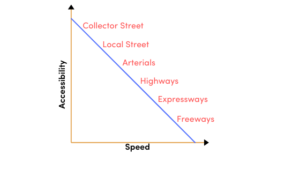
Speed and accessibility of different types of roads graph

5. Usage :
(i)   All-weather Roads
These are the roads which can be accessed throughout the year is called All-weather roads. 
(ii)  Fair-weather Roads

The roads which are accessed only during the fair atmospheric conditions are called Fairweather roads. Some roads are opened only during summers and rest all seasons the roads remained closed due to snow on road. These roads are not accessible during heavy rains, cyclones or at the time of floods.


6. Used Construction Materials :
(i)    Earthen Roads :

The roads which are laid with the available soil at the site are called Earthen Roads. These are the cheapest roads among all the roads. Earthen roads are designed for very low volume traffic. 

Available soil is laid in two-three layers and surface of the road is compacted with the rammer to expel the excess voids present in the soil.  roads are also called as temporary roads usually laid for moving constructing vehicles while building a structure or for moving army vehicles during war times.  


it is not recommended to go with Earthen roads in monsoon as the soil may runoff during rain.

(ii)   Marvel Roads
Gravel roads are the second cheapest among all the types of roads and they are also better than Earthen roads. 
In this type of roads, the mixture of gravel and earth (available soil at the site) is paved on the surface and compacted. Gravel roads are also called as metal roads. These types of roads are easily built and generally laid in villages. 

(iii)  Murram Roads 
Murram is a gravelly lateritic material which is occurred during the disintegration of igneous rocks by weathering agencies. The roads which are laid using Murram as primary material is called as a Murram road. The density of murram is higher than the gravel which also provides good surface finish and compaction than above two types of roads.

(iv)  Kankar Roads 
The word Kankar is derived from India which means an Impure form of Limestone. This type of roads usually recommended at places having a good quantity of lime. Kankar road is one of the low-quality roads but better than Earthen roads and gravel roads. 

(v)  Water Bound Macadam (WBM)

This type of road is also called as WBM road. The crushed stone (aggregate) is used as a base course. WBM roads are laid as layers. Aggregates are spread on the surface as a layer having 10cm thickness, water is sprinkled on each layer and then rolled for a better finish.  

These roads are better than the Murram, Earth and Kankar roads. 

In cities WBM is usually laid in pit holes. 

(vi)  Bituminous Roads

The bituminous is a black viscous and adhesive material occurred during the distillation of petrol. Bituminous roads are primarily used all over the world which is very easy to lay and provides smooth and good surface finish. The thickness of bitumen road depends upon the subgrade soil at the site. It is always recommended to lay the bitumen roads in two layers.


(vii) Cement  Concrete Roads

The roads which are laid using the cement concrete material is called concrete roads. These are the costlier roads among all type of roads. This type of roads are recommended at the places of the high volume of traffic and it takes more time to construct the concrete roads as the concrete requires proper curing. The average life of a concrete road is 40 years whereas bituminous road has an average life of 3 years.


7. Carriageway :
(i)   Paved Roads
The roads which are designed with a hard pavement course such as Cement concrete, Bituminous and WBM are called Paved roads. 
(ii)  Unpaved Roads
The roads which are not designed with a hard pavement such as Kankar, Earthen or Murram are called unpaved roads.  
8. Rigidity :
(i)   Flexible Roads

The flexible road has four layers, the outer surface layer is topped with bituminous material which is called as wearing course and an underlying sub-base, base and subgrade course. All these layers make the road flexible. Periodic maintenance is required for flexible roads otherwise it can disintegrate easily with heavy traffic. 

All roads except cement concrete roads are flexible roads. 

(ii)  Rigid Roads

These are the roads with only three layers (Surface course, Base and Subgrade course) makes road non-flexible. Cement concrete road falls under this category.

Flexible roads consist of a flexible layer as a pavement surface, which requires proper maintenance; otherwise, it can be disintegrated easily with heavy traffic. All types of roads except concrete roads fall under this category.

9. Topography :
(i)   Hill Roads
The roads which are constructed on hilly areas where one can see frequent steep bends, ups and downs. The capital required is more and it takes more time when compared with the plain roads.
(ii)  Plain Area Roads
The roads which are constructed on the plain area where there are very few bends, ups and downs are plain area roads. Planning and execution time is less when compared with the plain area roads.
10. Economy :
(i)    High Cost Roads
These roads require huge capital to construct. State Highways and National highways are the best examples of the high-cost roads. Bitumen or Cement concrete is used in High-cost roads. 
(ii)   Medium Cost Roads
The funds required for constructing medium-cost roads are higher than the low-cost roads. Road to travel from village to nearest town is one of the examples of medium-cost roads. These roads are considered when there is occasional high traffic. These roads are generally built using bitumen.
(iii)  Low Cost Roads 
The roads which require less capital and can be constructed with the available local soil or locally available materials are called low-cost roads. These roads are preferred where there is very low and pedestrian traffic. 
11. Traffic Type :
(i)    Cycle Tracks 
The tracks which are built especially for cycles or bicycles are called Cycle tracks. These tracks are provided on both sides of the pavement.
(ii)   Pedestrian Tracks 
The way or a route built specifically for the pedestrians where any vehicles are strictly restricted are called pedestrian ways.
(iii)  Motorways 
Motorways are expressways which are built for a free flow of very speed traffic. Expressways are designed to travel quickly with great comfort and safety by avoiding sharp curves, busy traffic intersections, railway junctions. Heavy load vehicles are strictly restricted on expressways.


What is Erec Prime? #malehealth #health&Fitness #health #fitness #wellness #wellbeing #erecprime

Click Here to Buy :  Erec Prime - Male Health ED, Testosterone Erec Prime appears to be a product or supplement designed to addr...